
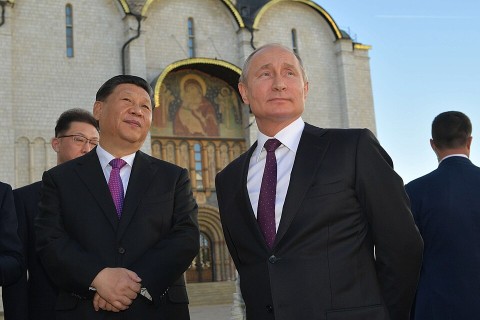
As Russian President Vladimir Putin prepares to visit Beijing this week, he and Chinese President Xi Jinping have exchanged congratulatory letters, underscoring the deepening ties between their nations. This exchange comes shortly after former U.S. President Donald Trump concluded a high-stakes summit in China. Xi remarked on the strengthened cooperation between Russia and China, a partnership that marks its 30th anniversary this year, according to reports from Chinese state media.
Putin is scheduled to arrive in China on Tuesday evening, with a meeting with Xi set for Wednesday morning, as reported by Kremlin aide Yuri Ushakov. The discussions between the two leaders will cover a range of bilateral issues, notably the proposed Power of Siberia 2 gas pipeline. Analysts have highlighted the significance of China hosting leaders from both the U.S. and Russia within such a short timeframe, an occurrence that is considered rare in the post-Cold War era.
The growing relationship between China and Russia has raised concerns in the West, particularly following Russia’s full-scale invasion of Ukraine in 2022. Western diplomats and analysts suggest that China’s economic and diplomatic backing of Russia has contributed to sustaining the conflict. Notably, Xi and Putin have met over 40 times, a frequency that surpasses Xi’s interactions with Western leaders. Since 2022, bilateral trade between the two nations has reached record highs, with China purchasing over one-quarter of Russia’s exports, including significant amounts of crude oil, which have generated substantial revenue for Russia’s war efforts.
China’s energy security has become increasingly crucial, especially as the Middle East crisis has interrupted oil shipments through the Strait of Hormuz. Since the onset of the Ukraine conflict, China has acquired more than $367 billion worth of Russian fossil fuels, according to data from the Centre for Research on Energy and Clean Air. In contrast, during Trump’s recent visit to China, the discussions reportedly centered on trade, Taiwan, and the Middle East, with little emphasis on the Ukraine conflict or Sino-Russian relations.
Joseph Webster, a senior fellow at the Atlantic Council, suggested that Taiwan might be a key topic in the upcoming Xi-Putin meeting, as Beijing could pursue additional fossil fuel agreements with Moscow to secure energy supplies amid potential future conflicts. An expansion of Russian oil pipeline capacity to China could significantly bolster Beijing’s energy security, particularly concerning Taiwan. Meanwhile, Russia is keen on advancing the Power of Siberia 2 gas pipeline, which would enhance the existing network’s capacity by 50 billion cubic meters.